
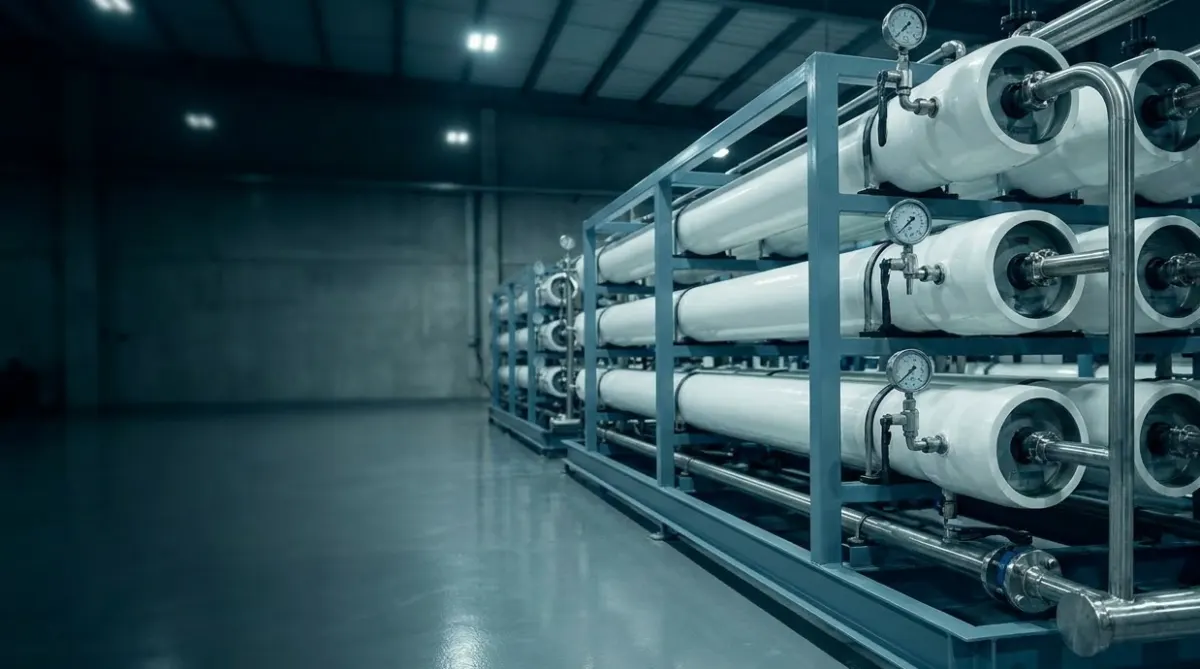
RO Membranes
Replacement 4" and 8" spiral-wound reverse osmosis membranes for brackish water, low-energy, fouling-resistant, high-rejection and seawater duties, supplied across Canada and the USA.
The part of your RO system that does the cleaning
Reverse osmosis membranes remove dissolved salts, organics, bacteria and other contaminants by pushing water through a semi-permeable thin-film composite layer under pressure. In a spiral-wound element, membrane sheets are wrapped around a central permeate tube with spacers between them, inside a 40" long fibreglass shell.
Membranes are consumables. Fouling, scaling and age slowly reduce flow and rejection, and elements eventually need replacing. We supply replacement elements in the industry-standard sizes, so they fit the pressure vessels you already have.
| Size | Typical use | Active area (approx.) |
|---|---|---|
| 4" × 40" | Commercial and light industrial | 80 to 90 ft² |
| 8" × 40" | Industrial and municipal | 365 to 440 ft² |
Active area varies by manufacturer and model. Use the membrane count calculator for a first estimate.
Choose the element for your water
Brackish water
The standard choice for well, surface and municipal water and most industrial RO.
Low-energy
Lower feed pressure for low-TDS water, cutting pump power.
Fouling-resistant
For feeds with higher organics or biological load, including wastewater reuse.
High-rejection
Where permeate quality is critical, for example ahead of EDI or mixed-bed polishing.
Seawater
High-pressure elements for desalination and high-TDS feeds.
Not sure?
Send us your feed water analysis and current element model, and we'll recommend a match.
When to clean, and when to replace
A common rule of thumb is to clean membranes when, compared with start-up and corrected for temperature and pressure, any of these happens:
- Normalised permeate flow falls by 10 to 15%
- Normalised salt passage rises by 5 to 10%
- Pressure drop across a stage rises by about 15%
Replace elements when cleaning no longer brings performance back, or after physical damage, telescoping or chemical attack such as chlorine exposure.
How long do RO membranes last?
It depends on the feed water, pretreatment and how often the system is cleaned. In well-run brackish water systems, elements commonly last several years, often three to five; poor pretreatment or chlorine exposure shortens that sharply.
Will your membranes fit my existing pressure vessels?
Standard 4" and 8" spiral-wound elements are built to common dimensions, so a like-for-like size fits a standard vessel. Send us the make and model of your current elements and we'll confirm a match.
Can I replace only some of the membranes in my system?
You can, but mixing old and new elements in the same vessel can unbalance flow. Partial replacement usually works best when a whole stage or whole vessels are replaced together.
How should new RO membranes be stored?
Keep them sealed in their original packaging, out of direct sunlight, in a cool place, and never let them freeze or dry out. Follow the manufacturer's storage instructions until installation.
What is membrane flux?
Flux is the permeate flow per unit of membrane area, in gallons per square foot per day (gfd) or litres per square metre per hour (LMH). Designing for the right flux for your feed water controls fouling and sets how many elements you need.